


Ecommerce is entering a new phase where customers aren’t always the ones doing the shopping.
Agentic commerce is emerging as a powerful shift in how purchases happen online. Instead of manually browsing, comparing, and checking out, consumers can now rely on AI agents to handle the entire process.
These agents don’t just assist; they act independently, optimizing for preferences, price, and convenience.
At the forefront of this shift, we can see Shopify. The platform’s agentic storefront capabilities signal that AI-driven shopping is already becoming a part of the infrastructure of modern ecommerce.
In this article, we’ll explore the capabilities of this technology, its differences from traditional AI tools you may already be using, the ways to implement it, and, most importantly, how it can benefit your ecommerce store on Shopify.
What is Shopify Agentic Commerce?
Let’s start by defining the technology behind the new Shopify plan release.
What is Agentic Commerce?
Agentic commerce means AI systems choose products for customers instead of customers browsing stores. Instead of scrolling through search results, a customer can ask, “What are the best running shoes under $200 in size 10 wide?” and the AI returns a short list of products that match the criteria, not a list of stores, but products across multiple stores.
This represents a fundamental shift in how people shop.
How AI systems evaluate products
These systems do not interpret your site the way humans do. They rely on:
- Structured product data (taxonomy and attributes)
- Product feeds (e.g., Google Merchant Center or Shopify Catalog API)
- Clean, crawlable product pages
The AI agent replaces much of the evaluation and decision-making typically done by the customer. Agents assess products based on structured data and relevance rather than visual browsing or brand storytelling.
Agentic Commerce vs Traditional AI in Ecommerce
Many businesses have been implementing AI in their operations for quite some time now. So you might ask, “How is this a new technology?” The answer lies in the fact that while this is an AI-based system, it takes a more independent approach to creating a bridge between an ecommerce store and clients. There are a few distinctive qualities that differentiate agentic commerce from traditional AI tools that have been used till now. Let’s look at these key differences.
| Aspect | Agentic Commerce | Traditional AI |
|---|---|---|
| Role of AI | Makes decisions for the customer | Only assists the client |
| Customer Journey | AI handles discovery, decision, and sometimes purchase | User handles journey with AI support |
| Interaction | Chat-based | Search, filter, on-site recommendations |
| Output | Curated product list across stores | Results within a single store |
| Checkout | Can happen inside an AI platform (if supported) | Happens on the website |
| Data Dependency | Highly reliant on structured data, feeds, APIs | Uses behavioral data, browsing history, and on-site indicators |
| Discovery Mechanism | Product feeds, catalog APIs, and indexing | SEO, ads, on-site search |
| Brand Visibility | Lower (AI abstracts brand in favor of the best match | Higher (client interacts directly with the brand) |
| Personalization | Based on query intent and structured data | Based on user behavior, history, and segmentation |
Overall, traditional AI assists shoppers, while agentic commerce acts on their behalf. This fundamentally shifts how products are discovered, evaluated, and purchased.
What Agentic Commerce Means for Ecommerce Brands
Agentic commerce is transforming the way things are discovered, evaluated, and purchased online. As all agents become mediators in purchasing decisions, businesses must adapt to a new commerce landscape.
- Product discovery is becoming more intent-driven
Instead of depending solely on keyword searches or visiting storefronts, AI agents recommend and compare products based on user intent, preferences, and context. Success is increasingly dependent on being the best match for a query, rather than simply the most prominent listing.
- The brand’s position in the customer journey has become less direct
In many cases, AI interfaces exist between shoppers and merchants, affecting which products are considered before a customer even enters your store. This impacts how brands gain attention and influence purchasing decisions.
- Structured data, feeds, and policies become crucial infrastructure
As AI-powered shopping expands, accurate product data, standardized feeds, and explicit policies become critical for discoverability, trust, and transaction readiness. They contribute to the understanding and visibility of your products in agent-driven encounters.
- AI interfaces have emerged as a new sales channel
Along with traditional ecommerce, marketplaces, and social commerce, AI assistants are providing a new avenue for discovery, suggestions, and even checkout. For brands, this is a new channel to plan for, not merely a new technology fad.
- Ecommerce marketing is developing
This broadens marketing beyond traffic acquisition alone. Product visibility in AI-driven discovery, data quality, and agent readiness are now part of the competitive strategy, alongside traditional performance and brand marketing.
Shopify Agentic Commerce Explained
Shopify Agentic Commerce is Shopify’s approach to enabling AI-powered shopping through its native infrastructure. It allows Al agents to surface Shopify products within conversations and, on supported platforms, assist customers in completing purchases without directing them to a traditional storefront.
Shopify enables this through agentic storefronts, which are configured within the Shopify admin.
Merchants have been informed that their products will become available for purchase directly through AI channels such as ChatGPT, Google AI, and Microsoft Copilot.

In these environments, users can ask for product recommendations (for example, “I’m looking for a high-quality painting starter kit”), receive suggestions, and complete purchases directly within the chat interface. Orders are still processed and fulfilled through Shopify, but the purchase happens inside the Al platform. This effectively creates a new sales channel. Agentic storefronts are automatically enabled, and Shopify handles the backend integration. Your role is to ensure your store is properly set up and optimized.
What is the Shopify Agentic Plan?
To make the new technology available to as many firms as possible, Shopify launched a new, specialized package.
The Shopify Agentic package is intended for brands that do not use Shopify as their primary online store but want their products to be discoverable through all of these new AI channels.
This plan allows merchants from any ecommerce platform to list their products in the Shopify Catalog and then utilize Agentic Storefronts to sync with AI assistants. This effectively opens up the entire Shopify-powered agentic ecosystem to any brand, regardless of where their website is housed.

The substantial benefit that can get brands interested in this plan is that it’s a free subscription service. When clients complete their purchases using an AI channel’s Shopify-powered built-in checkout, you just pay Shopify Payments or third-party transaction costs, depending on your payment method.
Core Components of Shopify Agentic Commerce
The Universal Commerce Protocol (UCP)
The first protocol is the Universal Commerce Protocol, or UCP. Consider it an ecommerce-specific universal translator. It’s an open standard co-created with Google that establishes a “common language” so AI agents and online stores can communicate seamlessly.

It solves a large problem. Without UCP, retailers would have to create unique integrations for every AI platform available (Gemini, Copilot, you name it). With UCP, you connect once and are ready for all of them.
This “common language” enables the AI to conduct all of the critical tasks, such as applying discount codes, allowing consumers to utilize their loyalty points, picking subscription alternatives, and validating your store’s selling terms, all without leaving the chat.
Shopify Catalog
This is a well-structured database containing millions of products from Shopify stores. AI agents may quickly scan this database to locate exactly what your consumers are looking for.
It even employs specialist AI to augment your product data, identifying categories and merging multiple product versions to provide buyers with the most relevant results.

Agentic Storefronts
Agentic Storefronts provide control over the Shopify Catalog. This is your new managing panel, located inside the Shopify admin. It’s where you control how your brand and products appear across all of the AI channels, including ChatGPT, Perplexity, and Copilot.
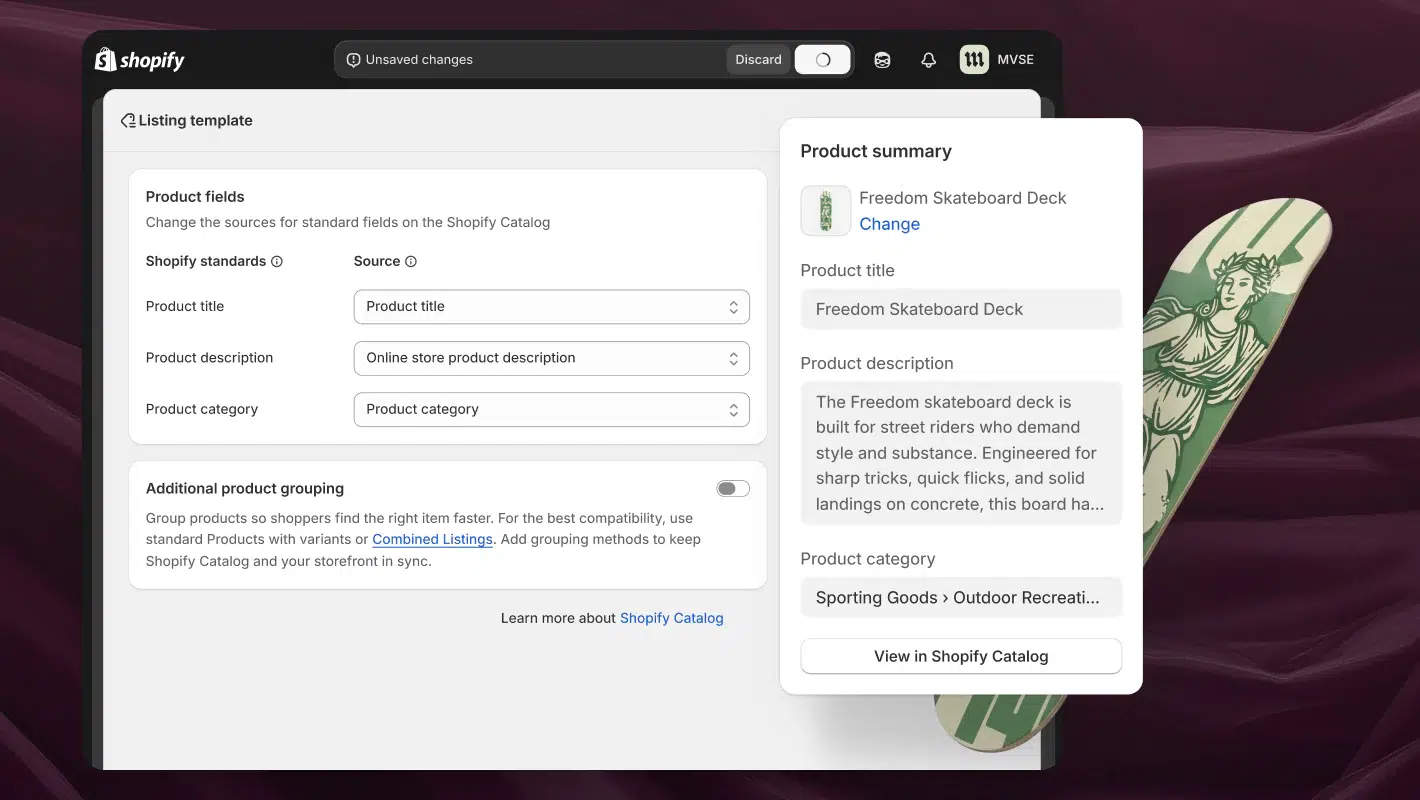
The primary advantage here is simplicity. You configure everything once, and your products are instantly discoverable everywhere, with inventory and pricing always up to date.
Universal Cart and Checkout Kit
Finally, Shopify brought everything together with two excellent features. The Universal Cart allows customers to add products from numerous Shopify sites to a single shopping cart, all within the same AI conversation.
So consumers can buy a jacket from one store and a pair of boots from another in a single, seamless transaction.
When they’re ready to purchase, the Checkout Kit kicks in. This solution integrates Shopify’s world-class, high-converting checkout right into the AI chat. This is vital because it assures that you, the merchant, are still the seller of record.

You have complete brand control over the final purchase experience, and the transaction is just as secure and reliable as it is on your own website.
How Shopify Agentic Commerce Works: Key Capabilities
Al agents use Shopify catalog data (pricing, availability, variants). Product data and brand context are made available through a single configuration; no custom integrations are required for each Al platform. If in-chat checkout is supported, the transaction is completed within the Al interface and appears in Shopify with proper attribution.

Example:
- A customer might say: “I’m a 40-year-old woman who recently started weightlifting. My feet are size 9 and wide. I have bad ankles, so I need stability. My favorite color is dark purple, not light purple. Find me sneakers under $90 for the gym.”
- The agent converts this into structured attributes like size, width, activity, color, price, and use case, then matches products accordingly. To be considered, your products must include as many relevant attributes as possible-ideally more than competitors.
Now that you know the main principles of how Shopify agentic commerce works, let’s look at its key features in more detail.
Structured Data
This product data on Shopify has two levels:
- “Buckets” (product categories)
- “Content inside those buckets” (attributes and values)
Both must be standardized for accurate comparison. This is where the Shopify Standard Product Taxonomy (SPT) comes in.
SPT also has two layers of its own:
- Product categories
- Attributes (category metafields)
Example:
Apparel & Accessories / Shoes / Athletic Shoes—each category includes predefined attributes (e.g., size, color, activity) with standardized values.
Shopify will increasingly send this structured data directly to Al agents. For now, categories and attributes are the most important because they are standardized.
Pro Tip:
To stay competitive:
- Assign a category to every product
- Fill out all relevant category attributes using SPT Shopify, which allows custom attributes, but agent feeds currently prioritize standard SPT values.
Conversational Commerce and Customer Service
You can automate high-volume inquiries (order status, returns, sizing, comparisons, product info) while escalating exceptions to staff. Ensure responses stay consistent by referencing approved policies and product data. Agents can also assist with need-based discovery (gift finding, compatibility checks, “best for” scenarios) and reduce back-and-forth. With proper permissions, they personalize support using order history, preferences, and customer context.
Al-driven Product Discovery and Recommendations
Agents recommend products based on purpose, context, and constraints-not just keywords. They can suggest bundles, alternatives, and best-fit solutions in real time.
Pro Tip:
Optimize product data for Al visibility. Ensure each SKU has comprehensive attributes, organized variants, detailed descriptions, and consistent metadata. Prioritize decision-making details
Autonomous Inventory Management
Agents rely on accurate availability signals to recommend products that are actually purchasable. They monitor sell-through, safety stock, and inbound inventory to support proactive replenishment and avoid stockouts.
Intelligent Order Orchestration and Fulfillment
Al agents can select fulfillment paths based on availability, location, delivery time, split-shipment trade-offs, and cost. You can set policy guardrails (margin floors, carrier preferences, capacity, geographic limits) and allow agents to operate within them, with exception handling when conditions change.
Why Businesses Look to Set Up AI Commerce on Shopify
Manual coordination between the web, markets, retailers, and third-party suppliers can no longer keep up. AI agents can help you balance inventory availability, service promises, and purchase decisions across several channels in real time.
Making your data and operations more agent-friendly early on can give you a competitive advantage by enhancing product visibility and conversion as AI-powered shopping grows. Here are the main benefits:
- Scalable Growth
With an increasingly competitive environment, it is critical to stay ahead of the competition with innovative and growth methods. Agents are the solution to ecommerce organizations’ scalability needs. Consider increasing productivity and making more informed decisions in partnership with agents that understand your business as well as you do. Consider those agents creating additional agents.
- Reduced Context Switching
It’s as simple as asking for what you want. Enable agents and start issuing prompt queries from a centralized chat window adjacent to a pane that shows what is going on behind the scenes.
- Ecommerce Personalization on Demand
Tailoring experiences for your customers is now easy. Based on your data, you can trust that when customers want specific products, accommodations, or services, agents will consistently and adaptively deliver them.
- Faster Time-to-Market
Agentic commerce makes it easier to get your products in front of prospective clients. As an extra benefit, you can spend more time on more complicated, human-centered duties such as research & development, company development, and product innovation.
How to Prepare Your Shopify Store for Agentic Commerce
Getting your store ready for agentic commerce isn’t about rebuilding your setup-it’s about refining your data, policies, and content so Al agents can accurately discover, evaluate, and sell your products.
Requirements and eligibility
Shopify specifies that there are a few important requirements that your store needs to meet if you want to implement agentic commerce.
To qualify:
- Your store must be based in the United States
- Products must be eligible for inclusion in the Shopify catalog
- You must agree to the terms of service
- You must have store policies in place
- Your store cannot require a customer login to purchase
Most standard Shopify stores already meet these requirements.
Key Steps to Set Up Shopify Agentic Commerce
Here’s a simple guide on how to implement this technology for your Shopify Store.
- Audit and Enrich Your Structured Product Data
Shopping agents use structured, machine-readable product data rather than exploring pages like humans. Ecommerce businesses must organize product characteristics such as title, price, materials, dimensions, and availability in standardized fields before submitting catalogs to platforms like Google Merchant Center and adding schema markup to product pages. This means that AI systems can readily recognize the product, its specs, and whether it meets a shopper’s requirements. Businesses should also avoid using unclear marketing language, organize product variants effectively, and keep critical information visible rather than hidden in page layouts or JavaScript.
- Develop Your Al-Facing Brand Presence
When proposing products to customers, all agents consider store policies, frequently asked questions, shipping information, pricing, and user reviews. Clear information regarding rules, such as free returns or shipping, enables AI agents to appropriately evaluate and suggest your business. Including customer evaluations and Q&A sections increases Al’s perception of product quality and relevance. If all platforms limit shared customer data, brands should publish policies and FAQs on easily accessible pages with clear titles, and customers should be able to opt into direct communication.
- Allow Agents to Sell Products for You
Agentic stores enable Al platforms to display a brand’s product catalog, checkout process, and branding information directly into Al chats. Shopify automatically distributes product data via Shopify Catalog, allowing platforms like ChatGPT, Copilot, and Google to discover and sell products. Orders generated through these channels are displayed on the store’s dashboard with channel attribution, and the merchant retains ownership of the customer relationship. Businesses on other ecommerce platforms can easily join this ecosystem by using the Shopify Agentic Plan, which connects their products to AI agents without the need for a new checkout system.
- Monitor and Improve Your Al Visibility
Brands should frequently evaluate how their items appear on all platforms by searching for them in the same way that customers would. Asking questions like “best [product category] under [price]” helps verify whether the brand is visible and the product information displayed is correct. Merchants can then assess which Al channels drive sales and monitor performance using channel attribution data. These insights enable firms to optimize product descriptions, data structure, and offerings, resulting in increased visibility and performance across all shopping platforms.
Conclusion
Shopify agentic commerce is a significant change in the retail industry, not just a catchphrase. We are transitioning from a world of static websites to one of dynamic, AI-powered interactions.
Flowium can help you extend your knowledge on current ecommerce trends and emerging technologies like agentic commerce. Check out our blog for valuable insights, or schedule a call with an expert to receive a top-notch consultation on any matter concerning ecommerce marketing.
Frequently Asked Questions
What is the Agentic Commerce Protocol?
The agentic commerce protocol specifies the rules and standards under which autonomous software agents communicate and transact independently on behalf of users or enterprises. It oversees secure, automated decision-making and execution in digital marketplaces.
How does agentic commerce differ from standard artificial intelligence in ecommerce?
Traditional AI frequently assists (e.g., chatbots, recommendations), whereas agentic AI can initiate and complete multi-step activities autonomously, learning and adapting over time.


